


24 Jan 2026
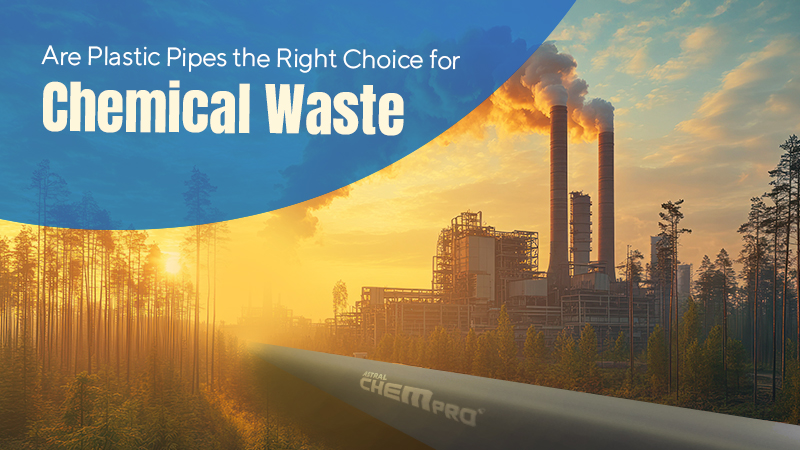
Are Plastic Pipes the Right Choice for Chemical Waste?
Are you worried about how your facility manages aggressive fluids? Many industrial managers in India find that traditional iron or steel lines fail much sooner than expected. Rust and leaks are not just a nuisance; they are a massive safety risk. You might be asking if a plastic system can truly stand up to harsh acids or boiling waste. The short answer is yes. In fact, plastic pipes are now the preferred standard across Indian manufacturing. Commonly known as chemical pipes, these specialised components are engineered to transport hazardous waste and fluids. They offer a level of safety that metal cannot match. This guide will walk you through the best materials and help you understand where a heat-resistant pipe is necessary for your operations.
Which Chemical Pipes Suit Your Industry?
Selecting the right material is the most important step in building a safe waste system. Different plastics react differently to heat and chemicals.
CPVC (Chlorinated PVC)
If you need a heat-resistant pipe that can handle more than basic waste, CPVC is a strong contender. It is an upgraded version of PVC that stays stable at higher temperatures.
- Best used for: Hot chemical lines and industrial processing
- Temperature limit: It functions well up to 93°C
- Pro tip: Always check the pressure capacity as the temperature rises
HDPE (High-Density Polyethylene)
HDPE is famous for being tough and flexible. It uses fused joints, which means the pipeline becomes one continuous piece without leaky gaps.
- Best used for: Underground transport and mining
- Advantage: It handles ground movement in Indian soil conditions very well
Polypropylene (PP)
PP is a versatile high temperature plastic pipe material. It has a broad range of chemical resistance and is quite popular in Indian pharmaceutical plants.
- Best used for: Pharmaceutical waste and sulfur-based acids
- Advantage: It offers better heat tolerance than standard PVC
Fluoropolymers (PTFE)
These are the premium options for extreme hazards. They are almost entirely inert, meaning they do not react with much.
- Best used for: “Lined piping”: where a steel pipe is lined with PTFE to handle the most aggressive chemicals at extreme heat.
- Temperature limit: Up to 260°C
- Advantage: Nothing sticks to it, and almost nothing reacts with it
Plastic vs Metal: Comparison for Indian Industries
| Feature | Plastic Pipes for Chemical Waste | Metal Pipe Systems |
| Corrosion | Will not rust or decay. | High risk of pitting and leaks. |
| Weight | Very light and easy to carry. | Heavy and needs more labour. |
| Flow | Smooth walls prevent clogs. | Rough walls lead to scale buildup. |
| Service Life | 25 to 50 years | Often fails in 5 to 15 years. |
Important Factors for a High-Temperature Plastic Pipe
Using a heat resistant pipe involves more than just checking a chart. You must look at how the physical environment changes when things get hot.
Understanding Thermal Expansion
Plastic expands much more than steel does. A long run of CPVC will grow in length as it gets hot. If there is no room for this growth, the pipe might buckle. Engineers use expansion loops to give the pipe space to move safely.
Pressure and Heat
As the temperature in a high temperature plastic pipe goes up, its ability to hold pressure goes down. This is called de-rating. You must never run a pipe at its maximum pressure and its maximum temperature at the same time. This is a common mistake that leads to early failure.
Chemical Compatibility of Joints
The solvent cement used to join chemical pipes must be as strong as the pipe itself. For very aggressive acids, heat-welding the pipes together is usually the safer choice. This removes the risk of the chemical eating away at the adhesive at the joints.
How to Choose the Right Pipes for Chemical Waste?
- List every chemical: Do not just look at the main waste. Even small amounts of a secondary chemical can damage certain plastics.
- Find the peak heat: Design your system for the hottest moment of the day, not the average temperature.
- Think about the environment: If the pipe is outdoors in the Indian sun, it needs UV protection or a specific coating.
- Check for permeation: Some chemicals can soak through plastic walls over a long time. Make sure your choice prevents this.
Explore Astral’s High-Resistance Industrial Pipes
When industrial environments demand more than just standard drainage, at Astral, our specialised piping systems provide the engineering excellence required for extreme temperatures and aggressive chemicals.
- Chem Pro: CPVC Industrial Piping System
For high-temperature chemical processing, the Astral Chem Pro system is the premier choice. As India’s first industrial-grade CPVC piping system, it is specifically engineered to handle aggressive acids, bases and salts at temperatures up to 93°C (intermittently up to 110°C). Available in Schedule 40 and 80, Chem Pro is ideal for metal treating, pulp and paper and pharmaceutical applications. Its solvent-weld joining process ensures a leak-proof, monolithic system that resists internal and external corrosion far better than traditional metal alternatives.
-

31 Mar 2026
Benefits of Using Multi-Layer Water Tank in India -
26 Mar 2026
Why Astral is Among the Leading CPVC Pipe Manufacturers in India -
18 Mar 2026
Majboot Hoon, Isliye Bharosemand Hoon: Dhurandhar × Astral Pipes -

11 Mar 2026
A World Without Plumbers: The Crisis We Never Saw Coming -
04 Mar 2026
What is the Difference Between Drainage and Sewage